
Words by Dorian Mode Photography Kims Beachside Retreat
With petrol prices doing what they’re doing and the Prime Minister urging restraint, the idea of travelling far begins to feel faintly irresponsible. Fortunately, Kims Beach Hideaway offers a luxury escape much closer to home – and your dog is welcome too.
Kims’ story begins in 1886 with a seafaring merchant of some vision, Captain Frans Charlson. Sailing his trading route to Norfolk Island, he would pause at a sheltered inlet then known as Chinaman’s Bay, drawn by a freshwater spring that ran down to a clean ribbon of yellow sand. He saw more than a place to refill barrels. He saw a place to linger.
Charlson established what he called “The Camp” at nearby Toowoon Bay, bringing guests with him on his voyages and collecting them on the return leg. It was, in effect, one of the earliest holiday packages, albeit with fewer brochures and more sea spray. He planted more than a hundred Norfolk Island pines along the coast, many of which still stand today, a quietly imposing legacy.
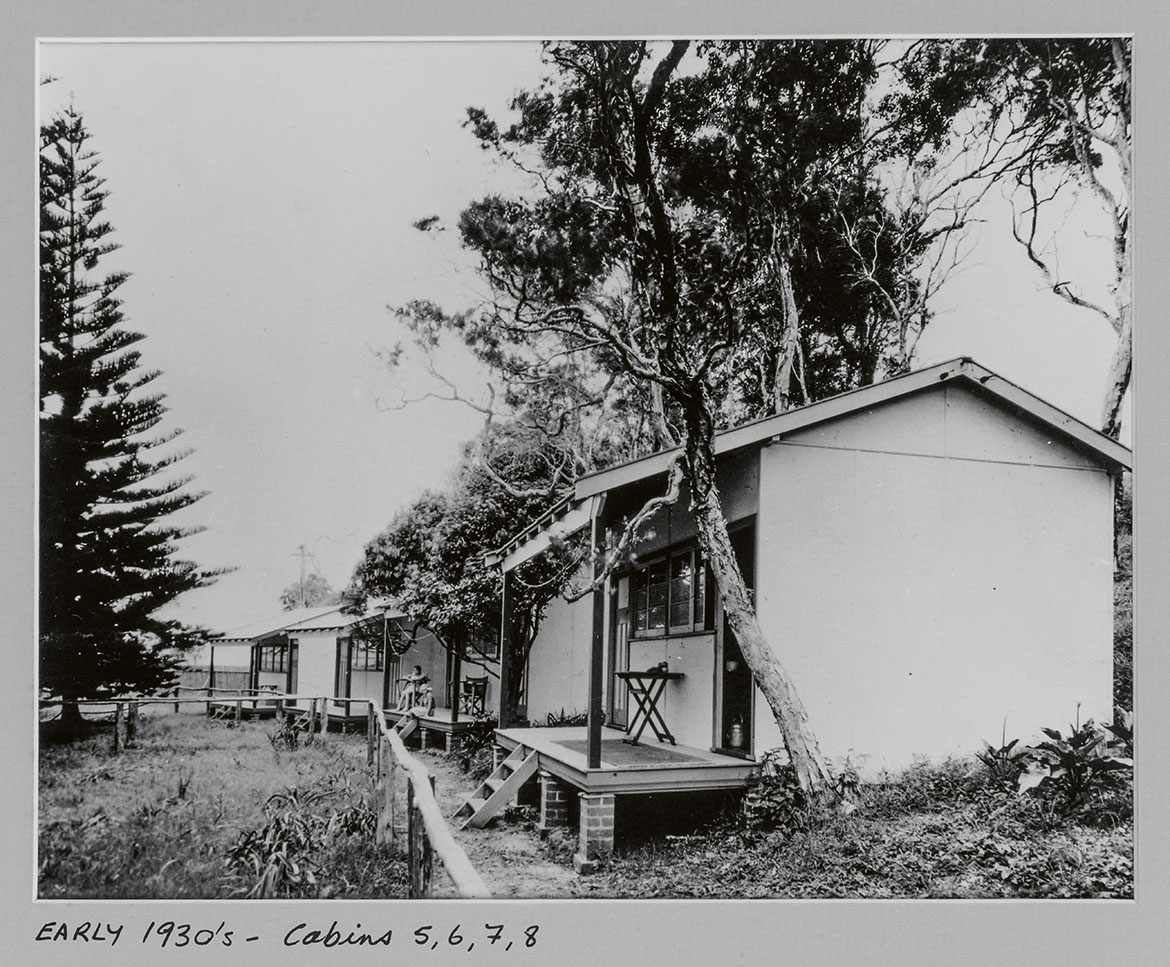
Accommodation was basic. Tents at first, then simple timber cabins, built from local hardwood hauled in by bullock teams from Tumbi Umbi, a Darkinjung name meaning ‘place of tall trees.’ A slab kitchen doubled as a dining room, and a brass bell summoned guests three times a day. In an era when pocket watches and sandy beaches did not agree, the bell was both practical and ceremonial, and it rang on for more than a century.


In its early years, Kims was a gentlemen’s retreat. Women were admitted only around the turn of the century, at a time when a day at the beach involved more fabric than water. Daylight bathing was, remarkably, illegal until 1902.
The 1920s brought a new chapter with the arrival of the McKimmins brothers, Americans who had already made their mark opening Sydney’s first ice cream parlours. They purchased the camp, improved the accommodation, and lent it their name. “Kims Camp” was born. Comfort, however, remained relative. Guests could expect bare timber walls, iron beds with kapok mattresses, and a chamber pot for late–night diplomacy.
In the 1940s, the property passed to a retired British army colonel with a résumé that reads like fiction. Colonel Clive Loc Hughes–Hallett had studied Japanese before the war, won a scholarship to Tokyo University, and quietly taken hundreds of clandestine photographs with a miniature camera. He later travelled through Vladivostok and across Siberia, reporting to British intelligence. By the time he arrived on the Central Coast, he brought with him both stories and, one suspects, a few lingering connections.
After World War II, the Colonel acquired the camp, shortened the name to simply “Kims,” and maintained its traditions with military precision. The dining room flourished under his watch, the bell still calling guests to the table as it had since Charlson’s time.

Then came a curious footnote in Australian Cold War history. During the 1950s, amid the fallout of the Petrov Affair, Vladimir and Evdokia Petrov were quietly hidden at Kims. For several months, Mr Petrov worked as a gardener, Mrs Petrov in the scullery. It was all handled with discretion, though not without a touch of gallows humour. A cluster of cabins at the far end of the property became known, with a wink, as “Siberia.”
In 1957, Haldane and Marie Strachan, along with their son Andrew, arrived and eventually took ownership as the Colonel retired. The name evolved to Kims on the Beach, and later to Kims Beach Hideaway, but the underlying character remained intact, quietly refined rather than reinvented.
Today, traces of that layered past are still visible. The cabins carry a faintly nautical air with their timber finishes and porthole skylights. At night, Norah Head Lighthouse blinks steadily to the north, as it would have for Charlson more than a century ago.
And if you stay, you may notice the resident jazz pianist working through a set of classics with the ease of long familiarity. He has been playing here for over twenty–five years.
As it happens, he also wrote this history.
handy websites & links
fast facts
Location: Toowoon Bay, Central Coast NSW
Getting there: Around 90 minutes from Sydney, or a short, smug drive if you’re already on the Central Coast. Follow the road through Gosford and you’re there, just behind the dunes.
The vibe: Adults–only coastal retreat tucked behind lush gardens. Relaxed, low–key, and quietly luxurious without making a fuss about it.
Rooms: Freestanding bungalows and spa villas set amongst sub–tropical gardens, many with ocean glimpses. Private, peaceful, and refreshingly disconnected. A small number of cabins are dog–friendly, so your well–behaved local can come along for the stay.
Dining: On–site restaurant included with most stays, long regarded as one of the Coast’s more reliable fine dining experiences. No theatrics, just consistently good food.
Facilities: Direct beach access, some cabins have a heated pool, spas, and Kims has beautifully maintained gardens that do most of the talking.
Best for: Couples, midweek escapes, or locals pretending they’ve gone much further than the Central Coast.
Not ideal for: Kids, large groups, or anyone chasing late nights.
Nearby: Bouddi National Park coastal walks, Long Jetty cafés, and some of the best low–key scenery on the Coast.
Price guide: From around $700–$1,200 per night depending on season and inclusions. Close to home, but it still feels like a proper getaway.